
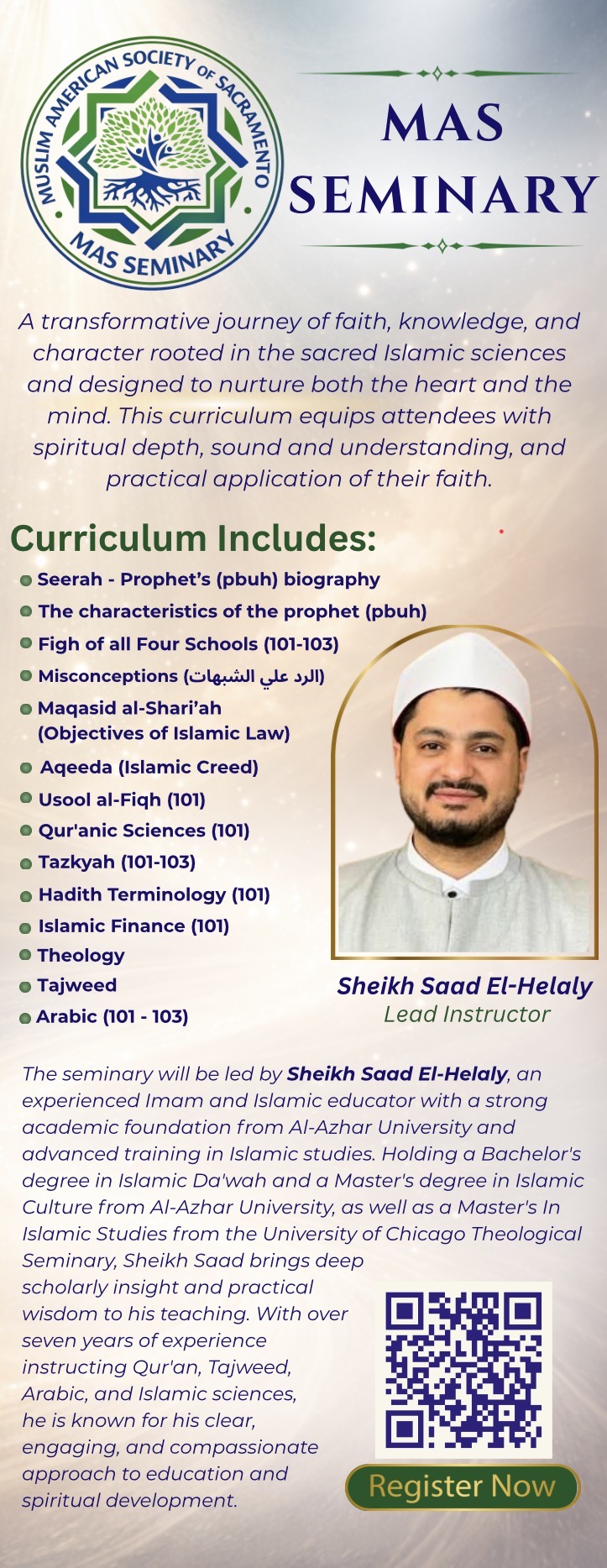
Program Details
Curriculum
Course Description
This course is 10 classes that aims to awaken the heart and enhance spiritual awareness by understanding the reality of faith, its strength and weakness, and ways to strengthen one’s connection with Allah. The course explores the role of the Qur’an in faith-building, how to benefit from it, the emotional impact of faith, and how to achieve spiritual fulfillment through prayer, supplication, and remembrance.
Course Objectives
By the end of this course, students will be able to:
- Understand the essence of human nature (heart, soul, intellect, body)
- Achieve a balanced approach to spiritual, intellectual, and physical well-being
- Learn how to awaken the heart and enhance faith
- Explore the Qur’an’s role in transforming lives
- Apply practical steps to benefit from the Qur’an
- Deepen love for Allah
- Analyze the connection between faith, emotions, and the Qur’an
- Enhance spiritual experience in prayer
- Strengthen the role of supplication, remembrance, and invocation in daily life
Course Outline
Week 1:
Balanced Spiritual Development in a Muslim’s Life
- Understanding the harmony between the soul, body, mind, and heart.
- The impact of faith-based education on personal development.
How to Awaken the Heart
- The importance of spiritual awakening.
- Practical methods to revive the heart’s connection with faith.
Week 2:
Fruits of Faith
- How faith influences a Muslim’s behavior.
- The benefits of strong faith in personal and social life.
The Qur’an as a Tool for Transformation
- The Qur’an’s power in shaping spiritual consciousness.
- How to interact with the Qur’an for personal growth.
Week 3:
Why Don’t We Benefit from the Qur’an?
- Barriers to the Qur’an’s impact on the heart.
- Steps to unlock the transformative power of the Qur’an.
How to Love Allah
- Reasons for weak love for Allah.
- Effective ways to deepen love and connection with Allah.
Week 4:
The Qur’an, Faith, and Emotions
- How the Qur’an influences spiritual emotions.
- The relationship between Qur’anic reflection and emotional well-being.
Supplication, Remembrance, and Invocation
- The role of supplication and remembrance in strengthening faith.
- Developing a daily habit of connecting with Allah through dhikr.
Week 5:
The Essence of Prayer
- Understanding the concept of khushu‘ (humility) in prayer.
- How to achieve spiritual enjoyment during prayer.
Final Reflection and Assessment
- Reviewing the key lessons of the course.
- Evaluating the impact of faith-based education on personal spirituality.
Course Description
This course introduces students to the fundamentals of reading Arabic using the Noor Al-Bayan method, a well-established phonetic approach. The course focuses on: correct pronunciation (Makharij & articulation), recognizing Arabic letters in all forms, developing reading fluency step-by-step, building a strong foundation for Qur’an reading. The course is designed for new Muslims, youth, and adults with no prior Arabic basics nor background.
Course Objectives
By the end of this course, students will be able to:
- Recognize all Arabic letters in their different forms
- Pronounce letters correctly using proper articulation
- Apply short vowels (Fatha, Kasra, Damma) in reading
- Distinguish between silent and pronounced letters
- Read short words and simple sentences fluently
- Write basic letters and simple words
- Understand basic elongation (Madd) rules
- Develop spelling and word-building skills
- Differentiate between Lam Shamsiya and Lam Qamariya
- Read basic Arabic texts with confidence
Required Materials
- Noor Al-Bayan Book
- Noor Al-Bayan Workbook
- Audio recordings (provided weekly)
Course Outline
Week 1:
Introduction to Arabic Letters
- Alphabet recognition (all forms)
- Basic pronunciation
Week 2:
Short Vowels
- Fatha, Kasra, Damma
- Reading simple vowel-based words
Week 3:
Sukoon, Shaddah & Tanween
- Silent vs. pronounced letters
- Introduction to Tanween
Week 4:
Madd (Elongation)
- Natural elongation (Alif, Waw, Ya)
- Reading practice
Week 5:
Spelling & Word Construction
- Breaking words into sounds
- Basic spelling skills
Week 6:
Reading Simple Sentences
- Fluency development
- Error correction
Week 7:
Lam Shamsiya & Lam Qamariya
- Rules and application
- Reading exercises
Week 8:
Reading & Writing Practice
- Short passages
- Writing drills
Week 9:
Review Week
- Comprehensive revision
- Practice exercises
Week 10:
Final Assessment
- Oral reading test
- Writing evaluation
- Individual feedback
Course Description
This course is 10 classes that provides an in-depth introduction to the terminology of Hadith science, tracing its historical development and exploring how scholars preserved and authenticated prophetic traditions. Students will gain foundational knowledge of Hadith classification, its authenticity criteria, and the major works in the field.
Course Objectives
By the end of this course, students will be able to:
- Differentiate between Mutawatir (mass-transmitted) and Ahad (solitary) Hadith.
- Understand the difference between authentic (Sahih) and weak (Da’if) Hadith.
- Identify the reasons for Hadith weakness.
- Analyze whether weak Hadith can be acted upon in Islamic rulings.
- Recognize the areas where Mutawatir Hadith is applied.
- Understand the applications of weak Hadith in different contexts.
- Comprehend the conditions of an authentic Hadith.
- Investigate fabricated (Mawdu’) Hadith, its dangers, how to detect forgery, and famous forgers.
- Study Imam al-Bukhari’s methodology in Hadith authentication.
- Understand why Sahih al-Bukhari is considered the most authentic book after the Qur’an.
Provided:
- Taysir Mustalah al-Hadith – Dr. Mahmoud al-Tahhan
Course Outline
Week 1:
Introduction to Hadith Science
- Origins of Hadith Terminology
- Major works in Hadith sciences
- Basic definitions
Categories of Hadith Based on Transmission Chains
- Mutawatir and Ahad Hadith
- Differences and implications
Week 2:
Ahad Hadith and Its Subcategories
- Famous (Mashhur) Hadith
- Rare (Aziz) Hadith
- Isolated (Gharib) Hadith
Mid-Term Review & Exam
Week 3:
Classification of Hadith Based on Authenticity
- Accepted Hadith (Maqbul) and its types
- Authentic (Sahih) and Good (Hasan) Hadith
- Contradictory Hadith (Mukhtalif al-Hadith)
Rejected Hadith (Mardud) and Its Causes
- Weak (Da‘if) Hadith
- Defects due to missing links in the chain
- Types of missing links
Week 4:
Hidden Defects & Reliability of Narrators
- Types of hidden defects
- Impact of narrator reliability on Hadith classification
- Exam & Review
Categories of Hadith Based on Attribution
- Qudsi Hadith
- Prophetic Hadith (Marfu‘)
- Companion Reports (Mawquf)
- Successor Reports (Maqtu‘)
- Shared characteristics of accepted and rejected
Week 5:
Final Exam & Course Wrap-Up
Registration Opening Soon
Course Description
This course is 8 classes that aims to dismantle the idols of the self, such as arrogance, self-admiration, egotism, tyranny, and envy. The course focuses on achieving true humility, sincerity, love for others, self-awareness, and the pursuit of knowing Allah (SWT). Through self-discipline and purification, students will work towards developing a purified soul, free from spiritual diseases.
Course Objectives
By the end of this course, students will be able to:
- Overcome arrogance and pride.
- Eliminate self-admiration and egotism.
- Cultivate sincerity and humility.
- Strengthen inner weaknesses and build resilience.
- Identify personal flaws and areas of self-improvement.
- Develop strategies for self-discipline and overcoming inner weaknesses.
- Attain true sincerity in actions and intentions.
- Establish genuine humility in personal and social interactions.
- Strengthen their connection with Allah (SWT).
- Achieve a deep sense of divine love.
Course Outline
Week 1:
Destroy Your Idol
- Identifying the self’s destructive tendencies.
- Understanding how self-admiration leads to spiritual downfall.
Symptoms and Dangers of Inner Weakness
- How spiritual weakness manifests in personal and social behavior.
- The impact of unchecked egotism and arrogance.
Week 2:
Causes and Solutions for Spiritual Weakness
- Understanding the root causes of inner weakness.
- Practical steps to overcome spiritual fragility.
Divine Training of the Prophet (PBUH)
- How Allah (SWT) nurtured the Prophet’s (PBUH) character.
- Lessons in humility and sincerity from the Seerah.
Week 3:
Spiritual Exercise as the Key to Self-Purification
- The concept of Riyadat al-Nafs (self-discipline).
- Daily practices to refine character and strengthen the soul.
Closing the Door to the Ego
- How to prevent the self from controlling one’s actions.
- Strategies to maintain spiritual vigilance.
Week 4:
Knowing Allah (SWT)
- The path to understanding Allah through self-reflection.
- Strengthening the connection with the Creator.
Sincerity to Allah and True Humility
- The reality of sincerity and its role in spiritual development.
- How humility leads to inner peace and a stronger faith.
Registration Opening Soon